Trying new things

GaryHusband
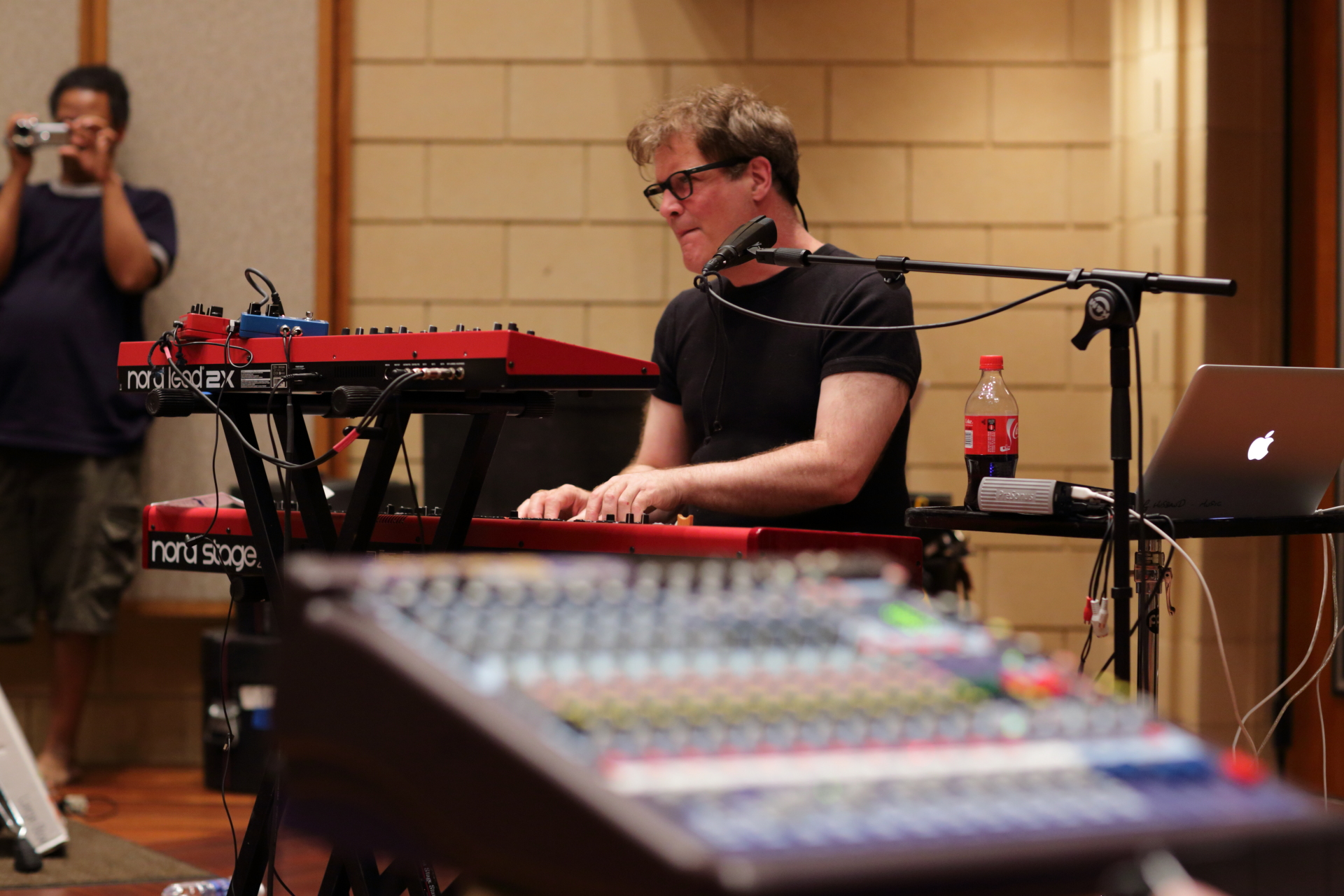
Gary Husband rehearsing at Manifold Recording

This week we have been given a gift.  Two of the most talented members of the Jazz fusion community are making a record at Manifold Recording.  And they are trying something new: the co-production model of The Miraverse.  If you are within 40 miles of Raleigh, Durham, Chapel Hill, or Pittsboro, you might want to consider becoming a co-producer on Friday, or at least having dinner with these artists and hearing what Alex Machacek and Gary Husband have been creating.

A lot has changed in the recording industry since John McLaughlin started recording with Miles Davis, but a few things have stayed the same: the laws of physics that govern acoustics have not changed, and the challenge of making a great record–from the technical practice to the acoustics to the critical decisions during tracking and mixing–remain challenges no matter how much technology one has available.  The co-production model is a new approach geared toward helping artists produce their art at the highest level, using both the most advanced technologies available and the most organic acoustic spaces in which to give their music life, and to do so in an economically sustainable way.

One major task of making a great recording is the recording process itself.  This process has its own magic, its own mystery, its own moments of enlightenment to offer.  And it is a process that is usually hidden from view, inaccessible to all except those directly connected to the process.  But what about those who love not only the music itself, but the process of producing the music?  In the world of local food, chefs are teaming up with farmers, bringing the restaurant to the field so that diners can experience food in a more complete and holistic way that just what is served on the plate.  Other artists are inviting people into their studios to witness the process of creation.  Why not do the same for the recording arts?

We are thrilled that Gary and Alex are trying new things.  And we hope that you might try something new as well and support the work of these artists in a new way.  It is quite something special to hear our 9′ concert grand piano in the Music Room.  It will be quite something special to hear Alex playing through our locally-made Carr amplifiers.  And if you decide to make a day of it and spend time not only hearing them play live, but participating in the recording process.

Leonardo DaVinci once said “Art lives from constraints and dies from freedom.”  Which means that art is defined by the choices made by the artist.  By seeing those choices being made, by understanding how those choices can be discerned in a recording, you might just find that you have a whole new appreciation for your existing library of recordings as you hear nuances (choices!) you’d never heard before.

Tickets for those who wish to attend are being handled by AbstractLogix here.

BREAKING NEWS: There is now an option to join only the post-dinner concert.  Contact AbstractLogix to check on availability of these $99 tickets.  We hope to see you Friday, either for the whole day, for dinner, or for the wrap-up performance.  Thank you for helping these artists produce the next milestones in Jazz recording.

Acoustic Magic (part 2)

In Acoustic Magic (part 1), we talked about techniques for getting great sounds from players in an indie rock band that plays with a horn trio.  Now it is time to turn our attention to Hindugrass, a band that brings together Sarod, Tablas, guitar, cajone, percussion, and a string quartet.  Some of the approaches will be strikingly familiar, others will be more novel.

Our goal in any tracking sessions is to get the best performance from the artist and the best sounds from the instruments.  This begins with an understanding of how the musicians like to play together, how they like to hear other instruments and the click, and how the instruments, the rooms, and the microphones all interact.

String quartet players have a way of listening to each other and playing with each other to make the sound of the quartet greater than the sum of its parts.  And it’s almost impossible to achieve that dynamic balance and synergy when recording one instrument at a time.  Booths A and B are each large enough to record four string players, but Ian decided to use the Music Room for that purpose because the other, more delicate instruments in the ensemble would actually sound better in the smaller acoustic environments of the Booths.  Ian again took advantage of the large space and numerous gobos to provide separation for each instrument, yet retaining the sound of the ensemble in the room.  Here’s Ian getting things rolling on Day 1:

And here’s an overview of the gobo arrangement:

Continue reading “Acoustic Magic (part 2)”

Acoustic Magic (part 1)

In previous blog postings, I previewed that we would have a very busy spring at the studio, and this has indeed come to pass.  We’ve done a lot of tracking, a lot of mixing, and not–unfortunately–a whole lot of blogging in the process. Let’s work on that, shall we?

There are many approaches to making a record, and even a few good ones.  The ones that get me the most excited are the ones that include the capture of great audio.  We are very proud of the acoustic quality of the Music Room and our Booths.  We also have an extensive collection of high-end microphones.  The art of the tracking engineer is using the microphones and the room acoustics to get the best performance from the artist and the best sounds from the instruments.  Here are some photos of recent tracking sessions that demonstrate the flexibility of our environment and the creativity of Ian Schreier, our chief engineer.

Here Ian sets a pair of close mics for a trombone:

Continue reading “Acoustic Magic (part 1)”

How Long Is This Gonna Take? [TrustMeImAScientist]

How Long Is This Gonna Take? asks and answers one of the most important questions that any artist must consider before embarking on a recording project.  The summary is pretty simple: while recording technology has dramatically lowered the cost of recording audio, there’s a lot more that goes into making a record that just getting bits onto a disk.  In the end, not much has changed in terms of overall time and cost.  What has changed is the many new ways that digital technology allow you to spend your time and your money, which is not necessarily a good thing.

Definitely worth a read!

Updates…can’t they just write themselves?

Before the studio opened, I had to content myself with taking photos of the construction progress and using Blender to visualize what the final studio might look like.  The five years it took to open the studio gave me plenty of time to organize my photos and write stories about them.  After we got the studio running, I essentially stopped taking pictures, mainly because I was busy doing too many other things.  I’ve finally gotten back into the rhythm of taking photos during sessions, but haven’t had the time to write the posts that do them justice.  Indeed, I still don’t really have that time.  But with hundreds of photos that are begging to be posted, I have to find a way…

The first batch are from the sessions we did with Matt Phillips.  Matt used Kickstarter to raise money for the recording project, a growing trend among artists who record here.  In this photo, Matt’s face tells you just how satisfied he is with the sounds he is hearing in the Control Room:

HappyMatt

See if you can hear the music in these photos:

Continue reading “Updates…can’t they just write themselves?”

Hindugrass Recording Sessions

Hindugrass will be recording next week, and they are kicking off their session with a performance on Friday night, April 12th at 8pm.  If you have always wanted to be a fly on the wall of a real recording session, the band is inviting a very limited number of people to be their guests in the studio via this Eventbrite link.

Why perform before recording?  Béla Fleck answers that question in this video from last year:

Continue reading “Hindugrass Recording Sessions”

Celebrating the Home Town Hero

We live in a paradoxical age: believe nothing unless you have seen it, yet trust outside experts more than the leaders of one’s own community.  All my life I have heard the quote “nobody is a hero in their home town” only to discover it’s a paraphrase of a verse from the Gospel of Luke, where Jesus says “Truly I tell you, no prophet is accepted in their own hometown.”  Doubtless Plato complained about the same problem hundreds of years earlier.  I believe this is due to our tendency to confuse the familiar with the ordinary.  Since moving to Chapel Hill and becoming familiar with many of the great people in the region, I have come to appreciate just how extraordinary so many of them are.  Including those with a musical inclination.

That is not to say that we don’t appreciate talent from other states or countries.  As a board member of Carolina Performing Arts, I’m rightfully proud of the world-class roster of international talents that perform at Memorial Hall each academic year.  But the greatness that comes from afar does not preclude the possibility of greatness living amongst us as well.  The INDY week article is a great case in point.  Yes, it may seem like bragging to use my own studio as an example of a world-class music and post-production facility in our community, but it’s true.  Equally true, and perhaps more important because of the network effect, is that the local community is able to come together and celebrate that fact.  Today, artists both local and global are willing to give us the nod over more established facilities in Nashville, New York, Los Angeles, and even London, which is now leading to greater opportunities for all in our growing community.  That is wonderful!

Continue reading “Celebrating the Home Town Hero”

Competition vs. Validation

 When I decided to leave the certainty of multiple steady paychecks to start a new company, everybody I briefed thought there was no possible way it could succeed, and that gave me the confidence that I’d have no competition.  The rest, as they say is history.  But since that time, I have also come to appreciate that sometimes it is more valuable to have at least some competition proving that the business idea has at least some merit.  Some percentage of a provable market is worth more than 100% of a market that simply does not exist.  Enter GrooveBox Studios.

GrooveBox Studios was born of a frustration that is nearly universal among all artists I’ve encountered: bands spend too much of their own money on projects and tours that generally enrich everybody else before the band earns a dollar.  Which is not sustainable.  The founders of GrooveBox Studios hit the business reset button and came up with a model that is really quite analogous to what we, too derived: the co-production model.  For starters, both GrooveBox and The Miraverse® promote the idea that instead of being an up-front cost that the artist must bear, the recording process is something that delivers cash and profit directly to the artist, up-front. Continue reading “Competition vs. Validation”

Zuill Bailey, Superhero

The North Carolina Symphony invited me to dinner on Monday, on stage with Zuill Bailey.  I’ve been to fundraising events before, and often they are fun, but I was really excited about this one because Zuill was part of the first-ever session at Manifold Recording.  The recording he played on, The Spanish Masters, reached the Top 10 on Amazon.com later that year.  The event exceeded all my expectations.

Continue reading “Zuill Bailey, Superhero”