
With everything looking good, Week 3 started to show real progress. In the first half of the week, trenches for the footings were dug. Here is the amazing backhoe that did that work:
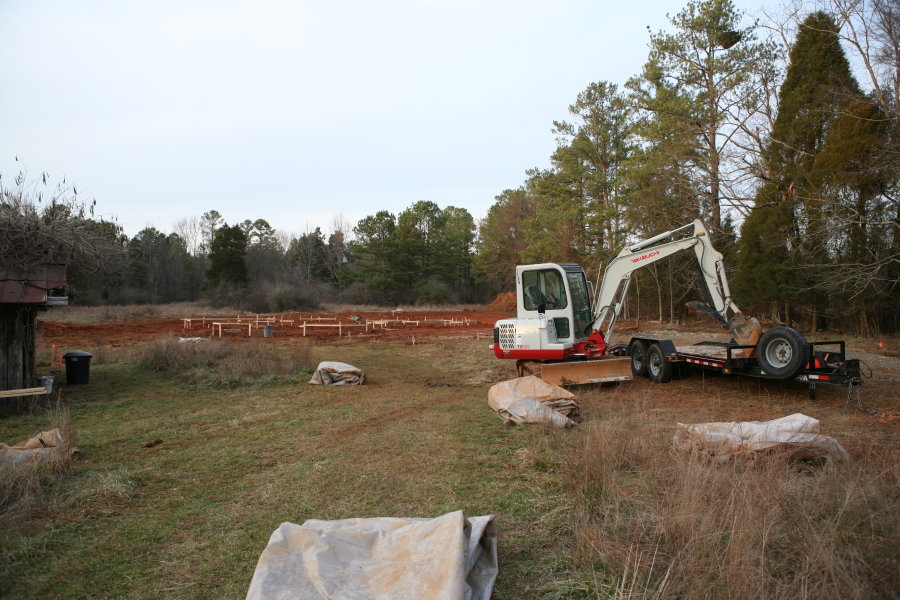
Why do I say “amazing”? Because the hydraulic backhoe was a revolutionary piece of machinery that made it economical to do constructions such as this one. As Clayton Christensen explains in his book The Innovator’s Dilemma the hydraulic backhoe was a product without a market when it was introduced in the 1940s. Cable-actuated steam shovels moved many cubic yards of earth with each scoop, whereas the first hydraulic backhoes could move only 1/4 cu yd of earth. When it came to digging the foundations of houses, or better yet, major buildings, or whole mountaintops, steam shovels were king. But when it came to digging trenches, their jaw were too wide to do the job. The lowly hydraulic backhoe was just the thing for digging trenches—much easier than doing it by hand. And today, that innovative technology is proving its value to this project.
Construction photos: week 2 (grading)
After the “first scrape” cleared out the surface material and verified that the dirt was good, the grading team set out to really find the best “finished floor elevation”. From the start, the vision for the building was to integrate it with the land. The topography of the location helped to dictate the size of the buildings, and also their shapes: hilltops are rarely square! Here are some photos showing the ground after “cutting in” as planned.
We’ll start with a tour of the site from the perimeter, starting at the garage entrance:
 .
.
Construction photos: week 1 (scraping)
After more than a year of planning, pleading, plotting, and praying, actual construction has begun! Here a photos showing the land just before and just after the first actual site work.
Let’s start the tour! These first two views are taken from near our lily pond (actually a rain garden that saves roof runoff). The first picture shows what it looks like in early summer, the second shows the disturbed area now under construction:


Next, we’ll see the before and after photos of the driveway:
More coming to the right side of the loudness wars
As reported in ocregister, Death Cab for Cutie are trading volume for quality and integrity in the loudness wars. And not a moment too soon! The acoustic assault of over-compressed songs not only fatigue the mind, but harm the ears as well. I’m glad to see that more people are starting to realize that a three minute song should not be mixed like a 30 second TV commercial.
You can read the full report at the ocregister website.
Fletcher writes about Discipline
One of my favorite internet forums is gearslutz.com. Filled with professional recording engineers, producers, and a reasonable number of musicians, it’s a great resource for reading about the technology, techniques, and aspirations of making great recordings. One of the posts to kick off the new year asked about discipline, and I particularly appreciated the response by Fletcher, one of the more colorful commentators on the list.
He begins by saying:
eSession.com — a modern way to produce music
Just before the new year I learned about eSession.com, a very well designed portal for hiring session musicians and producing music. Gina Fant-Saez has done a fantastic job engaging world-class studio musicians, engineers, and producers (who have a minimum of 15 major album credits) and creating an environment where requests can be made, tracks can be played, and talent can be paid.
I hope to meet with CEO Gina Fant-Saez on my next trip to Austin and discuss with her how the great work her team has done could possibly meet the infrastructure requirements of Manifold Recording and provide a commercial engine for The Miraverse. It is exciting to see so many good potential frameworks for launching a new generation of creative and commercial approaches to 21st century music production.
The Track Shack opens its doors
From their press release:
SACRAMENTO, CA — January 1, 2008—TheTrackShack.com today launched a brand new marketplace for musicians and fans to buy & sell CDs, Songs, and Tracks. Featuring the first ever CD mastered to offer production-level tracks, Bumped Up To First Class, the new site allows musicians to upload songs, including individual tracks, mix minus ones, videos, lyrics, and sheet music.
Why didn’t I think of that? 😉
Actually, there seems to be much more to it than just that, including a section for studios to list themselves and their services, artists to do the same, etc. Very much a one-stop-shop. I hope it becomes a viable means to unlock and refactor creativity and commerce in the music industry.
Stephin Merritt exposes his creativity
The NPR show All Things Considered issued a challenge earlier this year: write and record a song—in two days. Stephin Merritt took them up on their challenge, enjoying the benefits of NPR’s beautiful recording studio (studio 4a) fully stocked for his creative purpose.
You can see a video of that two day creative sprint on the NPR website, and you can form your own opinions about whether the challenge or the result are for the ages or not. My question is more technical: how well did the studio itself perform? How well did the video capture the creative process at work? If you had access to all 48 hours of recorded materials (multitrack inputs, video cameras, computer monitor outputs, etc), what would you want? What would you cut?
As Stephin himself acknowledges, the song itself had only one section–most popular music has at least two and usually three–so perhaps two days was a bit short. What could have been done in three days? What about five? And what about an elegant corpse model of music composition–what if three artists had been given the image and the word that one had selected, they agree on the key, tempo, and major thematic device (in this case, 1-9-7-4), and one did the verse, one did the chorus, and one did the bridge? How exciting might that have been upon reveal?
If you have links to similar experiments, please share!
David Byrne riffs on the music industry
David Byrne says:
What is called the music business today, however, is not the business of producing music. At some point it became the business of selling CDs in plastic cases, and that business will soon be over. But that’s not bad news for music, and it’s certainly not bad news for musicians. Indeed, with all the ways to reach an audience, there have never been more opportunities for artists.
I agree! See the full article at WIRED.
This American Life—the remix
I have always been a huge fan of This American Life because of all the shows on our NPR affiliate station WUNC that I listen to during the week, none make me laugh or make me cry so more rapidly, so frequently, or so powerfully as a typical episode of This American Life. A few months ago my wife Amy burned me a CD and said “you’ve got to listen to this—it’s so Miraverse you will die!”
 Manifold Recording / The Miraverse
You must be logged in to post a comment.