Peter Gabriel to adopt music co-producer model?

The Big Room @ Real World Studios David Rose tipped me off to this story titled Peter Gabriel Considers Allowing Fans Into Recording Studio.  The source for that story reports:

“The Incredible String Band wrote to their fans on their website and sold admission to their recordings… and that gave them the budget to purchase the studio time. They created a mini-economy based on 120 people.”

Props to Peter Gabriel for being able to manage the crush of 120 people in his studio (or at least be game to do so)!

Actually, I think this could be a significant turning point for the recording industry…

Continue reading “Peter Gabriel to adopt music co-producer model?”

The Police Give Back…Everything!

In Thursday’s USA Today’s Life section (August 6th, 2008), the article Police will bring on the night one last time caught my eye, and not just because I think that Sting’s Bring On The Night is one of the great live albums ever produced. Reporting revenues of $141M for the past year and a total of more than $346M worldwide is pretty eye-catching, too. But beyond the sheer economics of their tour, Stewart Copeland gives us a most astonishing insight. He said

We’re proud of this enormous monster we’ve created. But it owns us. The music doesn’t even belong to us anymore; it belongs to the people into whose lives it’s woven.

Wow.

Continue reading “The Police Give Back…Everything!”

Slow Food makes its way to the table

The objective of Fast Food, it seems, is to maximize short-term profits.  The eater profited by “wasting” as little time as possible eating, and the producer profited by sourcing the cheapest possible ingredients from the global economy, assembling those ingredients as rapidly and mechanically as possible, without regards to any externalities (such as the health of the eater, the quality of the food, the fairness to the farmer, and especially without regard to the environmental costs of the endeavor).  By contrast, the the objective of Slow Food is to create food that is good (pleasurable to eat), clean (healthy and regenerative to the environment), and fair (to farmers, chefs, and all who bring the food to the table).  Good, clean, and fair create a new triple bottom line for measuring the quality of food, and as the New York Times now reports, locally grown food is becoming de rigeur among the trend-setters.

“What I’m seeing with my clients is not the trendiness or the politics,” [chef] Mr. Welch said. “They are looking only at taste.”

Mrs. Howard said she ate local vegetables growing up in northern Michigan and Chicago. But her husband, a private equity fund manager, ate a lot of expensive imported food with little thought about where it came from. But all that has changed.

“It’s like the first time you start drinking good red wine and you realize what you were drinking was so bad you can’t go back to it,” Mrs. Howard said. “It’s that same way with vegetables.”

If a hedge fund manager can get this excited about vegetables, what might the future hold for music that is good (pleasurable to listen to), clean (faithfully recorded and produced), and fair (to the musicians, engineers, and all who bring the music to the listener)?

Continue reading “Slow Food makes its way to the table”

The Music Lesson

The Music Lesson (2006 Cover)

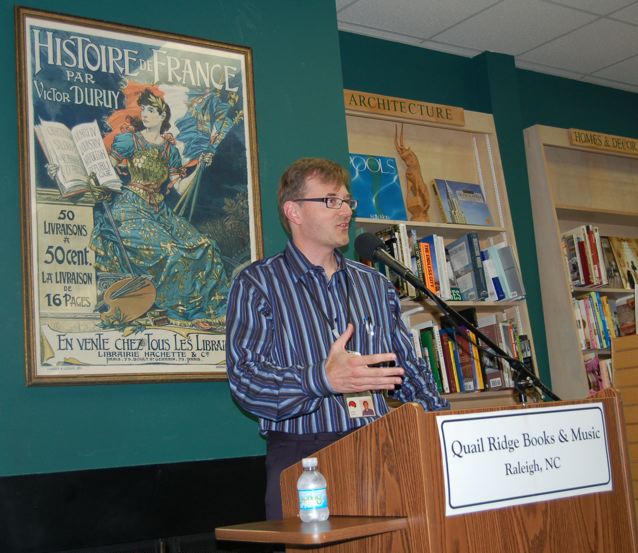
Last week Lyle Estill was scheduled to give a reading at Quail Ridge Books and I was asked to introduce him.  After his reading, which was excellent, and the questions, which were semi-interesting, he set himself to signing books for the 30+ people who came to hear him that evening.  And, being in one of the best real, local bookstores, I set myself to browsing.  I wandered over to the Music section, and was stunned to see that one of my favorite bass players, Victor Wooten, had written a book called The Music Lesson.  I cracked it to a random page, read the passage that said

“Sharing is on e of the most important tools needed for personal growth,” he once told me, also stating that many people never come to understand that point.  He said that many of us try to hoard our knowledge in order to stay ahead of everyone else.  I understood that completely because I used to use the same method.

Amen!

I had a trip to Oregon coming up, and I realized that with this book, I could be spending time with my man Victor.  Do you want to know what it was like?

Continue reading “The Music Lesson”

Music: Food for the Soul?

Another article by Robert Frank confirms that the most desirable purchase these days is not a thing, but an experience (a memorable meal to be precise). What’s up with that?

For data, Frank provides that:

A new study by American Express of their U.K. Centurion card holders (read: titanium-toting super-rich) found that “self-fullillment and learning” is the second-most-important priority for high-end vacationers. Number one was “value for money.”

Continue reading “Music: Food for the Soul?”

Orpheus and Euridice comes to Chapel Hill

“Welcome to Chapel Hill,” I said to Ricky Ian Gordon after the 8pm performance of Orpheus and Euridice at UNC’s Memorial Hall, “the best town you’ll find this side of the Underworld”. And what a wonderful performance it was.

At noon I had never heard of either the work nor the composer, but thanks to WUNC, Frank Stashio, and the friday episode of The State of Things, my ingorance was incrementally diminished.

Ricky Ian Gordon is not only a modern composer (the New York Times reviews him as blending Gershwin and Berstein, but I heard lots of John McGlaughlin’s wholetone diminished scales) but a poet as well. In fact it was his reading of the libretto that convinced me I needed to buy tickets and see the show that evening.

Wow!  Bravo to the Long Leaf Opera company for their daring and compelling performance!!

I was also delighted to hear him talk on the radio about the power of mythology, particularly the power that comes from mythology being a shared cultural currency. Indeed, what power would music or opera hold if every story were forced to be something unfamiliar, rather than allowing it to be something both true and Archetypical?

So thank you Ricky, for your courage, tenderness, suffering, and most of all, your generosity in sharing your love and grief with us.  And thank you for venturing from your New York haunts to visit us down here in Chapel Hill.

For those of you who missed the show, at least listen to the WUNC interview–it, too, is great art.

Anya Kamenetz asks "Who's American Dream is it Anyway?"

Silly me. While I’ve been focusing on how the music industry seems hell-bent on its own self-destruction, Anya Kamenetz has been looking a far larger picture: the whole American way of life. And I think she has a point.

Continue reading “Anya Kamenetz asks "Who's American Dream is it Anyway?"”

small is possible: reconstructing local music

small is possible book coverI just read Lyle Estill’s manifesto small is possible, an account of how he and others in Pittsboro, North Carolina (population 2,500) discovered how to feed, fuel, heal, and govern itself as a community.

First off, the writing is simply first-rate. Lyle writes with humor, but also with a very keen eye to the forces and effects that operate on multiple levels. But unlike Alexis de Tocqueville or Michael Pollan or Malcolm Gladwell, he is not merely an observer, but a passionate actor as well. And because Lyle practices the teaching “be the change you want to see in the world,” he has learned to farm, write software, weld steel, wire buildings, extend credit, teach classes, pull permits, and make peace with hunters.

Not all these many careers have been successful: he tried and failed yoga. And he tells this story of how, at the peak of the Internet Boom, he had the opportunity to Make It Big and utterly failed to comprehend the potential, as he explains:

“When Scott came to me to explain the future, I yawned. We would sit around after hours with core employees and argue about the coming of the net.

One night, our sales manager, Skip, said “Travel. Let’s take travel. How do you buy your tickets right now?”

I thought of Lisa, the preacher’s wife turned travel agent, who matched up the itineraries of Tami and Lyle [who would later marry] like a marriage counselor scheduling appointments, and I answered Skip’s question honestly:

“The other night I came out of my bathroom and found my travel agent at the kitchen table cutting up a lime on the cutting board. She had let herself in, and had brought over a ox of Corona beer.

“I sat down, grabbed a beer, and she told me that tonight we were going to get clear on whether or not Tami and I were going to Belize or Jordan. Tami came home late from work, grabbed a beer and settled into the conversation.

“Are you telling me that one day I will replace that with a computer screen?”

Continue reading “small is possible: reconstructing local music”

House Concerts and 21st Century Touring

Last year Chip and Dan Heath wrote Made To Stick: Why Some Ideas Survive and Others Die, and since them I have had a new appreaciation for sticky ideas and the market or strategic position they create. This morning I came across the gem featured in my blog post title, house concerts and 21st century touring.

Continue reading “House Concerts and 21st Century Touring”

Magic Numbers

Kevin Kelley has got me thinking.  While he’s blogging away in California, I’m having the exact same thoughts and discussions with people here in North Carolina.  Wild!

Consider this article written in March: 1,000 True Fans.  It quantifies what life in the long tail is like if an artist has a number of  “true fans” who would basically buy anything at a given price level year-in and year-out.  And it concludes that with 1,000 true fans, art is sustainable at a very reasonable cost.

But then in April, he argues against himself in The Case Against 1,000 True Fans.   His argument is that while the math is valid, there simply are not any musicians who have 1,000 true fans (other than those who benefited from the legacy of the old-world music biz).  And he’s asked his (substantial) readership to either help him find three (3) such people, or concede his case to Jaron Lanier.

Do you know of any such people?  I’d love to meet them!