NIN’s Alessandro Cortini On The Buchla 200e

Buchla 200e
Buchla 200e

In late 2005 I configured and ordered a Buchla 200e analog synthesizer, and after it was hand made by Don and Ezra Buchla, it was delivered in 2006.  It is the most confounding hybrid of organic and electronic logic I have ever encountered.  I spent a few months writing the Wikipedia entry for it, just so I could have a user manual.  And in the process I created a novel way to achieve portamento using analog components to control the MIDI module.  But I’m not an expert…Alessandro is. Continue reading “NIN’s Alessandro Cortini On The Buchla 200e”

Construction photos: week 33 (preparing for block delivery)

The construction plan shop diagrams call for somewhere around 15,000 architectural blocks, and those blocks need to go somewhere during construction.  Thankfully, we’ve got a whole meadow to play with.  Accordingly, we’ve staked and roped off areas that will become like library stacks for the 60+ block types that will comprise the 247(!) pallets to be delivered.

Empty Rows (East View) Empty Rows (West View)

Continue reading “Construction photos: week 33 (preparing for block delivery)”

Another music collaboration site on the web

At the beginning of this year I blogged about esession.com, and reports from many indicate that this Austin-based startup is delivering as promised, which is great.  I just learned of another site that appears to offer similar services with an international flavour: http://www.mymusicsession.com/.  I look forward to seeing how these sites enable/encourage greater musical collaboration and also whether musicians who meet through these sites ultimately find a reason to work together in a large tracking room.

Construction photos: weeks 19-32

My last construction blog post was week 18, and you might think that since we’re now up to week 32, we’ve come twice as far as when you last checked in.  Sadly, no.  All construction projects (I am told) suffer at least one inconceivably long and complicated delay, and that’s been the story this whole summer.  But there has been some concrete progress (literally), and so I figured I should share the latest photos.

First, to give you some idea of how long the delay has been consider these before and after shots…

Continue reading “Construction photos: weeks 19-32”

Canadians continue to fight passage of DMCA-like laws

The DMCA (Digital Millenium Copyright Act) was sold to the American people as a compromise: give media companies stronger powers to prevent people from copying their content, for longer periods of time, and in return they will make much more of their precious content much more available to many more people via the internet.  Passed nearly 10 years ago (October 12th, 1998), the DMCA has been nothing but trouble, allowing large media concerns to operate with powers unimagined when most of the subject content had been created, and to this date, they make precious little that will run with any of the kinds of freedoms we enjoy elsewhere in cyberspace.

The Canadians therefore enjoy 10 years of legal hindsight as their government attempts to “harmonize” its copyright legislation with the US.  And they seem to know that what has largely failed to increase content availability, access, and certainly profits (when it comes to music) for the US population doesn’t promise very much in the way of goodness for the much smaller Canadian population presently contemplating the legislation.  Michael Geist is one Canadian who surely must be singing “We Won’t Get Fooled Again” as he launches a cyber campaign to stop the maddness.  According to the article:

“We’re talking about more than just copyright here. We’re talking about the digital environment,” he said. “This legislation represents a real threat to the vibrancy of that online environment.”

Industry Minister Jim Prentice introduced the bill in June, calling it a “made-in-Canada” solution to online piracy. But critics responded that the bill was a carbon copy of the American Digital Millennium Copyright Act.

If passed, Bill C-61 would make it illegal to circumvent “digital locks” on CDs and DVDs and impose a $500 fine on anyone caught downloading illegal copies of music or movies.

Geist also launched a video contest on YouTube inviting Canadians to give their thoughts on Bill C-61 in 61 seconds. A panel of five judges, including Ontario Privacy Commissioner Anne Cavoukian, will announce the winner on Sept. 15 — the day MPs return to the House of Commons.

It’s late at night, so I don’t want to start a tirade about just how angry it makes me to see a perfectly decent government contemplating something so stupid, not to mention harmful.  And it makes me wonder whether the Canadian government really can be up to something like this solely because some lobbyist got ahold of some MP, or whether there is some behind-the-scenes deal cooking with the US.  Whatever the case, citizens in both countries should protest, Americans for the rights we have lost and Canadians for the rights they could lose if C-61 passes.

Michael, keep up the good fight!

The Police Give Back…Everything!

In Thursday’s USA Today’s Life section (August 6th, 2008), the article Police will bring on the night one last time caught my eye, and not just because I think that Sting’s Bring On The Night is one of the great live albums ever produced. Reporting revenues of $141M for the past year and a total of more than $346M worldwide is pretty eye-catching, too. But beyond the sheer economics of their tour, Stewart Copeland gives us a most astonishing insight. He said

We’re proud of this enormous monster we’ve created. But it owns us. The music doesn’t even belong to us anymore; it belongs to the people into whose lives it’s woven.

Wow.

Continue reading “The Police Give Back…Everything!”

Yahoo! Music Store closes…taking the keys with it

As reported in Ars Technica, customers who bought digitally restricted media (DRM) from Yahoo! Music Store will lose the technical ability to play the music they lawfully acquired.

As Corey Doctorow has been teaching for years:

1. That DRM systems don’t work

2. That DRM systems are bad for society

3. That DRM systems are bad for business

4. That DRM systems are bad for artists

5. That DRM is a bad business-move for [in this case, MSFT]

But his lecture applied equally to AAPL, and YHOO.  But as Upton Sinclair said many years ago “It is difficult to get a man to understand something when his salary depends upon his not understanding it,” and all these technology companies seem to believe that their paychecks depend DRM, whether practical, whether beneficial, whether profitable, whether fair, either in the general or in the particular.

But maybe this is a failure we can all learn from.  As long as the consuming public is ignorant as to the consequences of their actions, what cause have they to behave any differently?  Perhaps now that insult has become injury, more people will think twice about whether they really want to spend money on a right that can vanish with a shift of the economic winds. Perhaps they will reconsider the logic of a system which, after a finite time makes things less accessible to them instead of what the US Constitution promises, which is to shift the rights to the public after a limited time.

Slow Food makes its way to the table

The objective of Fast Food, it seems, is to maximize short-term profits.  The eater profited by “wasting” as little time as possible eating, and the producer profited by sourcing the cheapest possible ingredients from the global economy, assembling those ingredients as rapidly and mechanically as possible, without regards to any externalities (such as the health of the eater, the quality of the food, the fairness to the farmer, and especially without regard to the environmental costs of the endeavor).  By contrast, the the objective of Slow Food is to create food that is good (pleasurable to eat), clean (healthy and regenerative to the environment), and fair (to farmers, chefs, and all who bring the food to the table).  Good, clean, and fair create a new triple bottom line for measuring the quality of food, and as the New York Times now reports, locally grown food is becoming de rigeur among the trend-setters.

“What I’m seeing with my clients is not the trendiness or the politics,” [chef] Mr. Welch said. “They are looking only at taste.”

Mrs. Howard said she ate local vegetables growing up in northern Michigan and Chicago. But her husband, a private equity fund manager, ate a lot of expensive imported food with little thought about where it came from. But all that has changed.

“It’s like the first time you start drinking good red wine and you realize what you were drinking was so bad you can’t go back to it,” Mrs. Howard said. “It’s that same way with vegetables.”

If a hedge fund manager can get this excited about vegetables, what might the future hold for music that is good (pleasurable to listen to), clean (faithfully recorded and produced), and fair (to the musicians, engineers, and all who bring the music to the listener)?

Continue reading “Slow Food makes its way to the table”

The Music Lesson

The Music Lesson (2006 Cover)

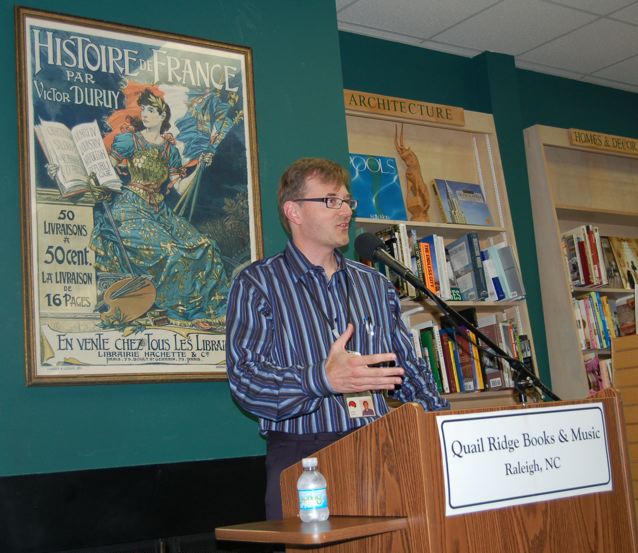
Last week Lyle Estill was scheduled to give a reading at Quail Ridge Books and I was asked to introduce him.  After his reading, which was excellent, and the questions, which were semi-interesting, he set himself to signing books for the 30+ people who came to hear him that evening.  And, being in one of the best real, local bookstores, I set myself to browsing.  I wandered over to the Music section, and was stunned to see that one of my favorite bass players, Victor Wooten, had written a book called The Music Lesson.  I cracked it to a random page, read the passage that said

“Sharing is on e of the most important tools needed for personal growth,” he once told me, also stating that many people never come to understand that point.  He said that many of us try to hoard our knowledge in order to stay ahead of everyone else.  I understood that completely because I used to use the same method.

Amen!

I had a trip to Oregon coming up, and I realized that with this book, I could be spending time with my man Victor.  Do you want to know what it was like?

Continue reading “The Music Lesson”

Music: Food for the Soul?

Another article by Robert Frank confirms that the most desirable purchase these days is not a thing, but an experience (a memorable meal to be precise). What’s up with that?

For data, Frank provides that:

A new study by American Express of their U.K. Centurion card holders (read: titanium-toting super-rich) found that “self-fullillment and learning” is the second-most-important priority for high-end vacationers. Number one was “value for money.”

Continue reading “Music: Food for the Soul?”