Welcomed home by Stanley Jordan (and Bob Edwards)

Joi Ito invited me to be a speaker at the 2008 Ars Electronica Symposium and Festival, held each year in Linz, Austria. I chose to speak about Music, Software, and Sustainable Culture, tying together my free software and free culture sensibilities. But after discharging those responsibilities, and after meeting tons of new people and sharing lots of new information, it was time to come home.

Continue reading “Welcomed home by Stanley Jordan (and Bob Edwards)”

Ars Electronica 2008: Music, Software, and Sustainable Culture

The following blog posting is an electronic version of the paper I presented at the Ars Electronica 2008 Symposium.  I hope you enjoy reading it as much as I enjoyed writing it!  You can also download the pdf file.

Music, Software, and Sustainable Culture

Michael Tiemann

“A Nation that destroys its soil destroys itself.”

—President Franklin D. Roosevelt
A letter sent to Governors on February 26, 1937

If we are to discuss the limits of intellectual property in the age of a new cultural economy (or vice-versa, the question of what new cultural economy can exist within the limits of modern-day intellectual property), we must first define the nature of these two subjects. Only then can we describe and then reason about their relationships and interactions with one another.

Continue reading “Ars Electronica 2008: Music, Software, and Sustainable Culture”

Seeds of Shakti grow in Durham

John Heitzenrater teaches sarongPage counts and advertising revenues may be down at our local newspaper, the News and Observer, but we still subscribe because it still brings us a lot of good news, reporting, and commentary.  This morning I read a particularly inspiring article about John Heitzenrater, an expert in South Asian instruments.

The article begins by noting that Heitzenrater’s roots are Swedish, his accent American, “[but] when John Heitzenrater fiercely strums the sarod, the music resonates, transcending geographical and ideological boundaries.”

It turns out that Heitzenrater was inspired by one of the great boundary-trascendents, John McLaughlin

Continue reading “Seeds of Shakti grow in Durham”

NIN’s Alessandro Cortini On The Buchla 200e

Buchla 200e
Buchla 200e

In late 2005 I configured and ordered a Buchla 200e analog synthesizer, and after it was hand made by Don and Ezra Buchla, it was delivered in 2006.  It is the most confounding hybrid of organic and electronic logic I have ever encountered.  I spent a few months writing the Wikipedia entry for it, just so I could have a user manual.  And in the process I created a novel way to achieve portamento using analog components to control the MIDI module.  But I’m not an expert…Alessandro is. Continue reading “NIN’s Alessandro Cortini On The Buchla 200e”

Canadians continue to fight passage of DMCA-like laws

The DMCA (Digital Millenium Copyright Act) was sold to the American people as a compromise: give media companies stronger powers to prevent people from copying their content, for longer periods of time, and in return they will make much more of their precious content much more available to many more people via the internet.  Passed nearly 10 years ago (October 12th, 1998), the DMCA has been nothing but trouble, allowing large media concerns to operate with powers unimagined when most of the subject content had been created, and to this date, they make precious little that will run with any of the kinds of freedoms we enjoy elsewhere in cyberspace.

The Canadians therefore enjoy 10 years of legal hindsight as their government attempts to “harmonize” its copyright legislation with the US.  And they seem to know that what has largely failed to increase content availability, access, and certainly profits (when it comes to music) for the US population doesn’t promise very much in the way of goodness for the much smaller Canadian population presently contemplating the legislation.  Michael Geist is one Canadian who surely must be singing “We Won’t Get Fooled Again” as he launches a cyber campaign to stop the maddness.  According to the article:

“We’re talking about more than just copyright here. We’re talking about the digital environment,” he said. “This legislation represents a real threat to the vibrancy of that online environment.”

Industry Minister Jim Prentice introduced the bill in June, calling it a “made-in-Canada” solution to online piracy. But critics responded that the bill was a carbon copy of the American Digital Millennium Copyright Act.

If passed, Bill C-61 would make it illegal to circumvent “digital locks” on CDs and DVDs and impose a $500 fine on anyone caught downloading illegal copies of music or movies.

Geist also launched a video contest on YouTube inviting Canadians to give their thoughts on Bill C-61 in 61 seconds. A panel of five judges, including Ontario Privacy Commissioner Anne Cavoukian, will announce the winner on Sept. 15 — the day MPs return to the House of Commons.

It’s late at night, so I don’t want to start a tirade about just how angry it makes me to see a perfectly decent government contemplating something so stupid, not to mention harmful.  And it makes me wonder whether the Canadian government really can be up to something like this solely because some lobbyist got ahold of some MP, or whether there is some behind-the-scenes deal cooking with the US.  Whatever the case, citizens in both countries should protest, Americans for the rights we have lost and Canadians for the rights they could lose if C-61 passes.

Michael, keep up the good fight!

The Police Give Back…Everything!

In Thursday’s USA Today’s Life section (August 6th, 2008), the article Police will bring on the night one last time caught my eye, and not just because I think that Sting’s Bring On The Night is one of the great live albums ever produced. Reporting revenues of $141M for the past year and a total of more than $346M worldwide is pretty eye-catching, too. But beyond the sheer economics of their tour, Stewart Copeland gives us a most astonishing insight. He said

We’re proud of this enormous monster we’ve created. But it owns us. The music doesn’t even belong to us anymore; it belongs to the people into whose lives it’s woven.

Wow.

Continue reading “The Police Give Back…Everything!”

The Music Lesson

The Music Lesson (2006 Cover)

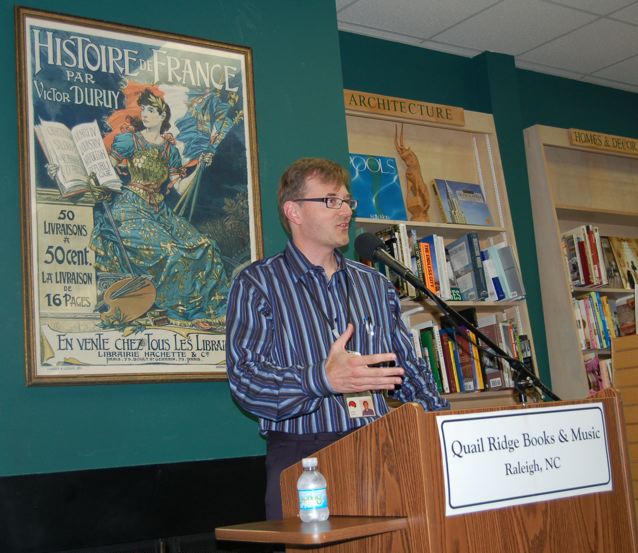
Last week Lyle Estill was scheduled to give a reading at Quail Ridge Books and I was asked to introduce him.  After his reading, which was excellent, and the questions, which were semi-interesting, he set himself to signing books for the 30+ people who came to hear him that evening.  And, being in one of the best real, local bookstores, I set myself to browsing.  I wandered over to the Music section, and was stunned to see that one of my favorite bass players, Victor Wooten, had written a book called The Music Lesson.  I cracked it to a random page, read the passage that said

“Sharing is on e of the most important tools needed for personal growth,” he once told me, also stating that many people never come to understand that point.  He said that many of us try to hoard our knowledge in order to stay ahead of everyone else.  I understood that completely because I used to use the same method.

Amen!

I had a trip to Oregon coming up, and I realized that with this book, I could be spending time with my man Victor.  Do you want to know what it was like?

Continue reading “The Music Lesson”

Power, Passion, and Beauty

Last month I had the opportunity to read Power, Passion, and Beauty, the story of the Mahavishu Orchestra, published by AbstractLogix. As many of you can imagine, I’m a huge fan of John McLaughlin, and as a fan, the book did not disappoint. Meticulously researched the book’s organizing structure of a timeline lets history tell the story without the author getting in the way. And what a history it was…

Continue reading “Power, Passion, and Beauty”

Red Floor Records

Daniel Lanois is pursuing a new business model with Red Floor Records. I will be checking out the music of his first release, the soundtrack to the movie “Here is What Is”, but I have to confess, based on the description, I really want to see the movie (or the DVD)! From the site:

For those of you who might not know, the film is a camera following me around over the course of a year, in and out of recording studios documenting once and for all the way it really happens. We start in Toronto and end in Morocco.

Continue reading “Red Floor Records”

Magic Numbers

Kevin Kelley has got me thinking.  While he’s blogging away in California, I’m having the exact same thoughts and discussions with people here in North Carolina.  Wild!

Consider this article written in March: 1,000 True Fans.  It quantifies what life in the long tail is like if an artist has a number of  “true fans” who would basically buy anything at a given price level year-in and year-out.  And it concludes that with 1,000 true fans, art is sustainable at a very reasonable cost.

But then in April, he argues against himself in The Case Against 1,000 True Fans.   His argument is that while the math is valid, there simply are not any musicians who have 1,000 true fans (other than those who benefited from the legacy of the old-world music biz).  And he’s asked his (substantial) readership to either help him find three (3) such people, or concede his case to Jaron Lanier.

Do you know of any such people?  I’d love to meet them!